

The Two Dimensions of Great Management
ManagementAudit analyzes your management behavior across two independent dimensions grounded in organizational psychology: Clarity of Direction (does the team know where they're going and what they're empowered to decide?) and Psychological Safety (can people speak up, raise concerns, and admit mistakes without fear?).
The intersection of these two dimensions determines your zone on the 3×3 management matrix — from Chaos Trap to High Performance Zone. One click Auto-Fix rewrites your statement toward the High Performance Zone (Clear Direction + Psychological Safety) — Amy Edmondson's Learning Zone.
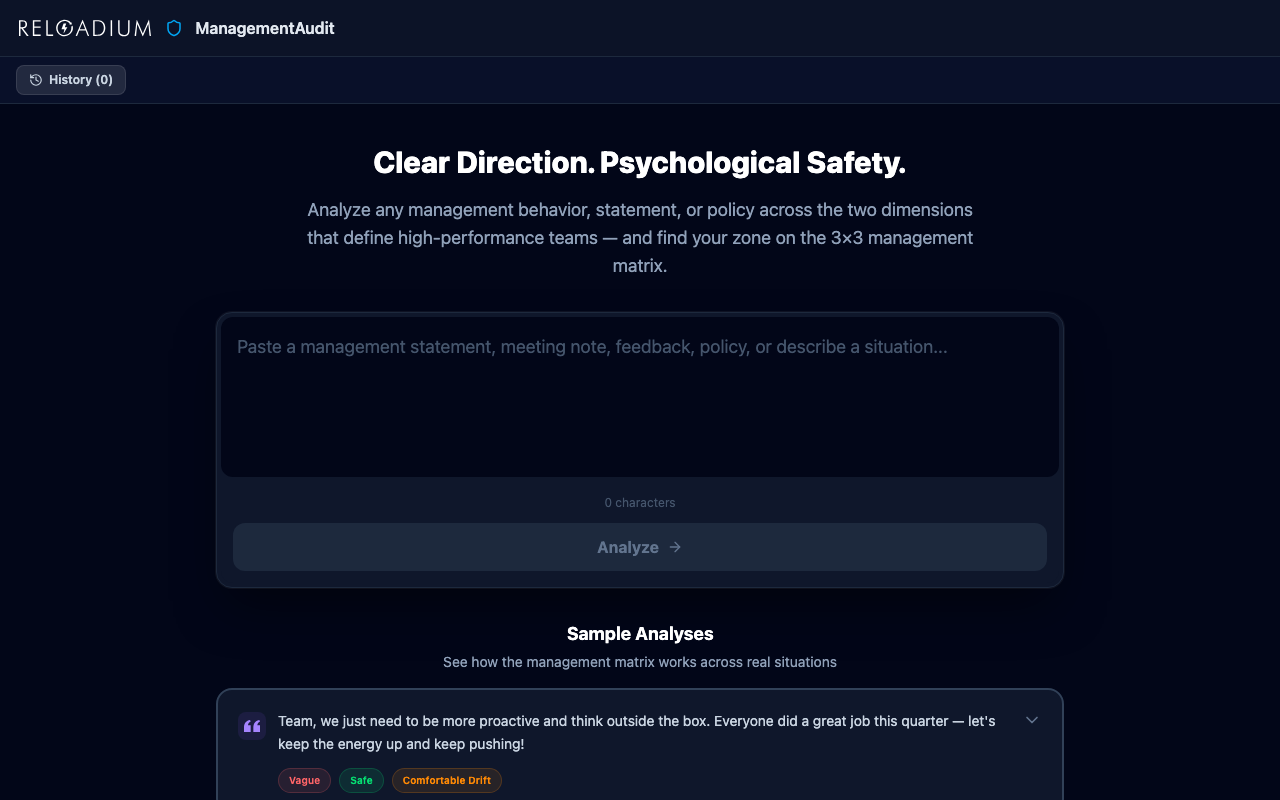
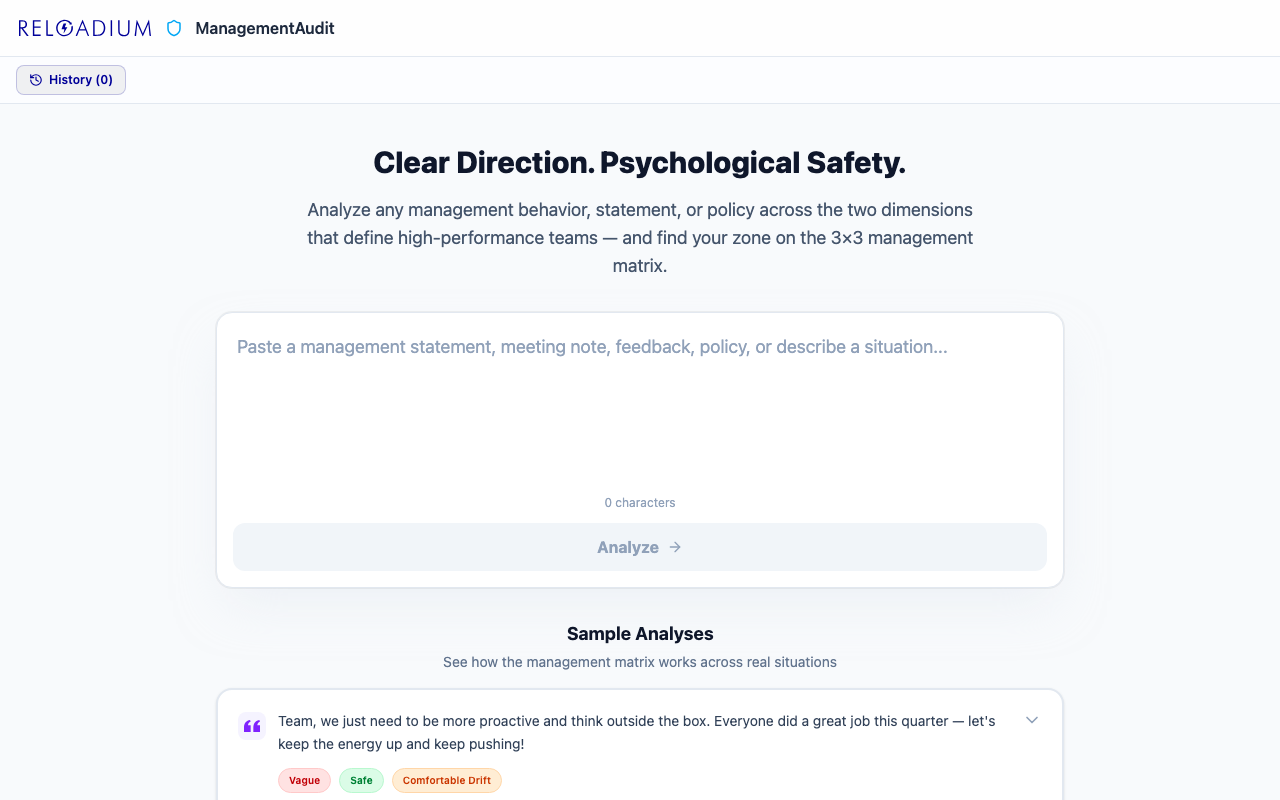
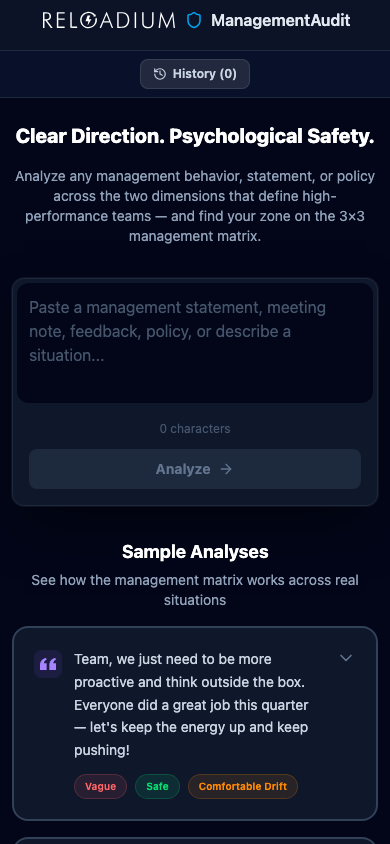
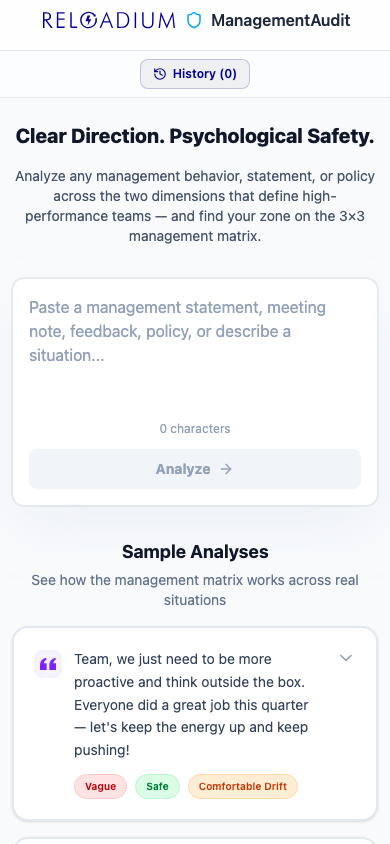
Screenshots
App Screenshots
Key Features
Built-in Agentic AI Assistant
Every Reloadium app comes with a built-in agentic AI assistant. It can perform any task the app offers — just describe what you want in plain language. Attach images or documents, keep a persistent conversation history, and let the AI act on your behalf — no extra setup required.
Clarity of Direction Analysis
Determines whether your communication is Vague (no actionable anchor, fuzzy success criteria), Clear (specific outcomes, explicit decision rights, defined constraints), or Overspecified (every step prescribed, no autonomy — dehumanizing at scale).
Psychological Safety Scoring
Assesses whether your behavior creates Unsafe (speaking up feels risky, self-censorship the default), Safe (mistakes are information, questions welcomed, dissent possible), or Coddling (challenge avoided to protect feelings, honest feedback withheld).
9-Zone Management Matrix
Maps your behavior to one of nine zones: Chaos Trap, Comfortable Drift, Enabling Ambiguity, Execution Machine, High Performance Zone, Sheltered Clarity, Micromanagement Hell, Process Theater, or Control Bubble.
One-Click Auto-Fix
Rewrites your management statement toward the High Performance Zone (Clear + Safe) with targeted fixes for your specific issues — preserving your natural communication style and intent.
Analysis History
Persistent IndexedDB storage of all your analyses lets you track management style improvements across statements, meetings, and feedback sessions over time.
Markdown Export
Export full analysis reports as Markdown files for documentation, 1:1 prep, or team retrospectives.
Analyze Any Webpage
Paste any URL and the AI reads the page for you. Feed in articles, competitor pages, reports, or documentation — the full content becomes context for a richer, more grounded analysis.
Upload a Document
Drop in a PDF, Markdown, or plain text file and let the AI work from your actual content. Ideal for analyzing contracts, research papers, internal reports, or any document you'd rather not copy-paste.
Zone Recognition Trainer
Sharpen your understanding of the zone matrix with AI-generated scenario drills. Read a realistic situation, pick the zone it belongs to, and get instant feedback. Scenarios are generated in your language and cached locally so you can keep practising without regenerating.
How It Works
-
1
Paste a management behavior
Any text: a feedback statement, meeting summary, policy announcement, OKR framing, 1:1 note, performance review, or even a Slack message.
-
2
Get your zone
Gemini 2.5 Flash analyzes clarity of direction and psychological safety independently, then maps you to one of nine zones with a real-world team impact description.
-
3
Read the detailed diagnosis
Understand exactly what dimension is creating friction — vague goals, punishing tone, over-prescription — with specific, actionable suggestions to improve.
-
4
Auto-fix toward High Performance Zone
One click rewrites your statement with targeted fixes for your specific zone, in your own voice, preserving your intent.
Perfect For
Team Managers
Audit your weekly updates, feedback sessions, and team meetings before sending. Catch vague goals and unsafe tone before they land.
Engineering Leads
Diagnose sprint planning and OKR framing. Distinguish between 'good pressure' (Clear + Safe) and 'bad pressure' (Clear + Unsafe) before the next sprint review.
First-Time Managers
Learn the difference between directing and micromanaging, and between honest feedback and psychological safety violations — with concrete before/after rewrites.
HR & People Ops
Use the matrix to coach managers on specific behaviors, not personality traits. Map policy announcements across the 3×3 before distributing them company-wide.
Executive Coaches
Give clients an objective framework for self-diagnosis. The 9-zone matrix surfaces patterns that are hard to see from inside the relationship.
Leadership Educators
Use real-world examples across the 3×3 matrix to teach the difference between clarity and control, and between safety and coddling.
Powered by Advanced AI
ManagementAudit uses Google Gemini 2.5 Flash to deliver nuanced two-dimensional management analysis. Our technology:
- Analyzes management behavior against a structured Clarity × Safety framework
- Returns JSON-structured output with zone, impact, summary, and suggestions
- Rewrites statements toward the High Performance Zone targeting specific weaknesses
- Stores all history locally in IndexedDB — zero server-side data retention
- Runs securely through the Reloadium /api/hello cloud function with Firebase Auth
Privacy & Data
We respect your privacy and are committed to protecting your data:
- Your content is sent to the AI for analysis only — not stored on our servers
- All history is stored locally in your browser via IndexedDB
- Firebase Authentication is used for secure credit-based access
- No content data is retained after each analysis session
Frequently Asked Questions
Is there a built-in AI assistant?
What is the High Performance Zone?
What's the difference between clarity and psychological safety?
What's the difference between 'Unsafe' and 'Coddling'?
What's wrong with 'Overspecified' direction?
Can the same situation map to different zones?
Is this based on academic research?
Can I analyze a webpage or article directly?
Can I upload a file instead of typing?
What if I don't know what to type?
What is the Zone Recognition Trainer?
From Our Blog
Ready to Find Your High Performance Zone?
Paste any management statement, policy, or feedback and get instant AI-powered zone diagnosis.
Launch ManagementAudit